


Trading risk disclaimer. This content is for educational and informational purposes only. It is not financial or investment advice. Cryptocurrency and automated trading involve substantial risk, including the possibility of losing your invested capital. The assets, platforms, settings, thresholds, and examples here explain how grid trading works. They are not recommendations or guarantees of profit. Do your own research and make decisions based on your circumstances and risk tolerance.
A grid trading strategy automates the classic "buy low, sell high" approach by placing a ladder of orders at fixed price intervals. It suits sideways markets, where strategies that need a direction to be right struggle. The harder part is identifying the best coin pairs for grid trading, then deciding how to set the spacing, allocation and stop-loss.
I wish someone had explained that to me before I burned through my first $2,000 trying to time the market manually.
TL;DR: Key Takeaways
- Works best in ranging markets. As a conservative screening heuristic, this guide uses $10 million in 24-hour volume on the pair itself before looking at range behavior and spread.
- Requires predefined risk limits, including a stop level and a cap on how much capital you are willing to expose to the grid.
- Some platforms generate grid parameters automatically from recent price history and volatility, but there is no universal optimal spacing for major crypto pairs.
- A 24/7 VPS can keep self-hosted or API-connected grid bots running when your local machine is offline.
How a Grid Bot Places Orders
Grid trading is an automated strategy that places a network of buy and sell orders at regular price intervals around a base price. When price drops to a buy level the bot buys, and when price rises to a sell level it sells for a preset profit, repeating through the range for as long as price keeps crossing those levels.
Instead of trying to predict whether Bitcoin will moon or crash, you establish a price range and let the orders work the oscillations inside it.
Think of it like setting multiple fishing nets at different depths. Some catch fish while others remain empty, but you don't need to predict exactly where the fish will swim. The work is in positioning your grid inside the range the asset has actually been trading in. (My first grid looked more like a tangled mess than organized fishing nets.)
Grid Trading vs Traditional Approaches
Discretionary trading asks you to be right about where price goes next. A grid asks only that price keeps moving inside a band you picked.
| Aspect | Grid Trading | Traditional Trading |
|---|---|---|
| Direction Prediction | Not required | Often required |
| Market Conditions | Best in ranging markets | Varies by strategy |
| Execution | Fully automated | Manual or semi-automated |
| Profit Source | Price oscillations | Directional movements |
| Time Commitment | Minimal monitoring | Active management |
| Emotional Impact | Reduced | High psychological stress |
How Grid Trading Works and How to Configure It
Modern grid bots can run 24/7 once configured. Some platforms generate parameters automatically from recent price history and volatility, but those calculations differ by platform and should be treated as starting points rather than guaranteed optimal settings. Unexpected news or a sudden breakout can make even a sensible initial configuration stop fitting the market.
Core Grid Components & Configuration
Price Range Definition: Setting upper and lower boundaries around support and resistance zones visible in recent price action. Tools such as Standard Deviation Bands can help, but the range should reflect levels the price has actually respected.
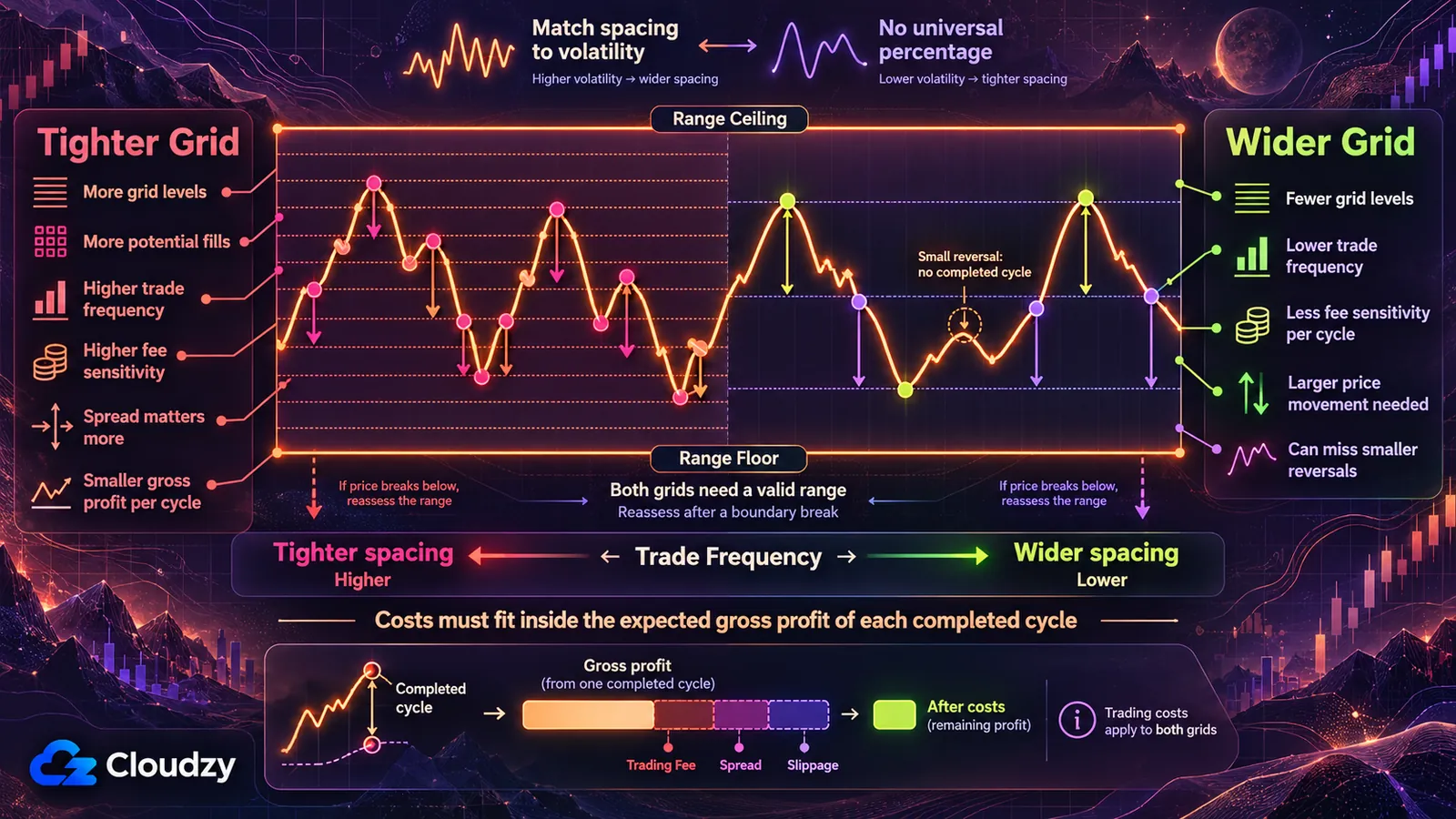
Grid Level Spacing: Distance between individual buy and sell orders, set with reference to recent volatility while leaving enough room for trading fees, the spread and likely slippage.
Position Sizing: Amount invested at each grid level, which can be equal across all levels or weighted based on distance from current price and market conditions.
Profit Taking Parameters: The gross profit targeted on each completed grid cycle, which needs to leave enough room for trading fees, the bid-ask spread and likely slippage.
Step-by-Step Setup Process
My first grid bot ran for exactly 6 hours before I panicked and shut it down when I saw red numbers. Turned out I'd set the spacing too tight and was bleeding fees.
- Market Analysis. Analyze recent price history to identify support and resistance levels that will define your grid boundaries. Examine 30-day price charts to identify consistent support/resistance zones where prices frequently reverse.
- Platform Selection. Compare platforms based on trading fees, supported pairs, grid controls and whether the bot runs natively inside the exchange or through an external connection. If you are comparing approaches beyond grids, our guide to the best trading bot strategies covers other automated methods.
- Parameter Configuration. Set spacing wide enough that the expected gross profit from a completed grid cycle exceeds trading fees, the spread and likely slippage. Use recent volatility to decide how many levels fit inside the range rather than applying one fixed formula to every pair.
- Capital Allocation. Set a maximum capital allocation before the bot starts based on how much you can afford to expose to the strategy. Avoid increasing that limit simply because the grid has recently performed well.
- Risk Management Setup. Define a stop before launch at a price where your original range assumption no longer holds. The appropriate distance depends on the pair's market structure and your risk limit rather than a universal percentage below the lowest grid.
- Technical Infrastructure. If you are running a self-hosted or API-connected bot that must remain online to place or replace orders, run it on an always-on machine rather than a laptop that may sleep, reboot or lose its connection. Exchange-native grid bots do not require your own machine to stay online.
- Launch & Monitor. Start with conservative settings and monitor performance at regular intervals, including total trades executed, average profit per trade and maximum drawdown. Avoid changing parameters in response to every short-term market move.
For a bot that actually depends on your own machine staying online, that failure mode is one you can move off your laptop. Cloudzy's Forex VPS keeps the bot on a machine that stays awake, with published 99.95% uptime.
Grid Strategy Quick Reference
Grid width affects trade frequency, fee sensitivity and the kind of price movement the bot can capture. Comparing wider and tighter grids is more useful than labeling either setup inherently conservative or aggressive.
| Setup Element | Wider Grid | Tighter Grid |
|---|---|---|
| Grid Spacing | Fewer, wider intervals | More, narrower intervals |
| Trade Frequency | Lower | Higher |
| Fee Sensitivity | Lower | Higher |
| Best Fit | Larger oscillations inside a defined range | Liquid pairs with tight spreads and frequent smaller oscillations |
| Main Trade-off | Can miss smaller reversals | Fees and spread consume more of each cycle |
| Risk Limit | Set separately from grid spacing | Set separately from grid spacing |
Spacing is where fees decide whether any of this works. Every completed cycle is two trades, so you pay the exchange twice: at Binance's 0.10% entry-tier fee (as of October 2026), a round trip costs about 0.2% of the traded amount, which leaves roughly 0.1% on a 0.3% grid before anything else goes wrong, while Pionex's 0.05% leaves more of it. Match spacing to the pair's volatility, wider when it swings hard and tighter when it is quiet, but never so tight that a completed cycle earns less than the round-trip fee. Treat spacing as an execution setting, not a return target.
How to Find the Best Coins for Grid Trading
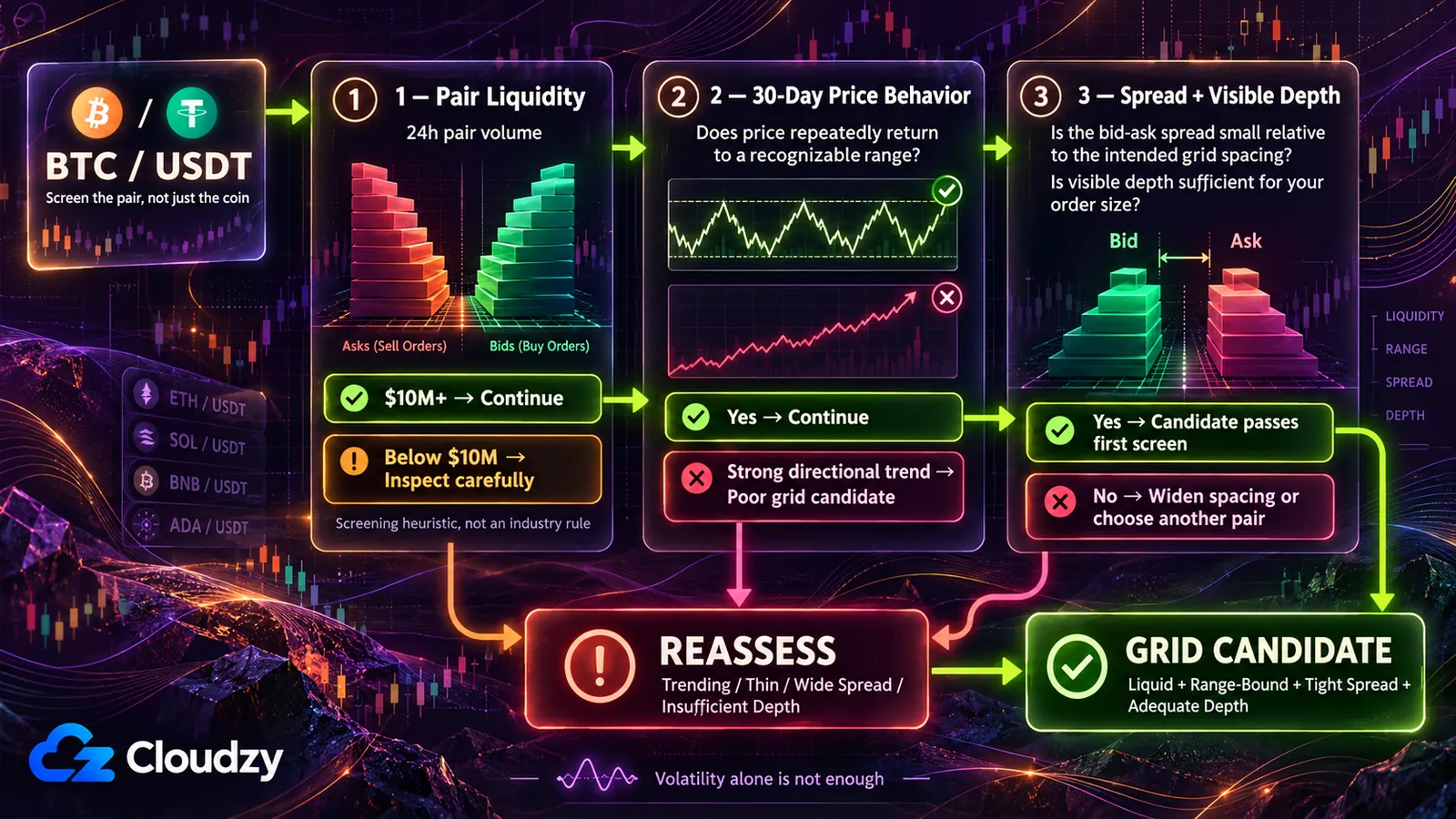
The best coin pairs for grid trading are not a fixed list. A pair that suited a grid last quarter may be trending this one, so learn how to check a pair instead of memorizing a list. Three things to check on your own exchange before you commit, in this order:
- 24h volume on the pair, not the coin. BTC/USDT and BTC/EUR are different order books, and the one you are trading is the one that has to be deep. The $10 million floor in the TL;DR is this guide's screening heuristic, not an industry standard. Below that threshold, thinner depth and wider spreads can make tight grid spacing less reliable, so inspect the actual order book before committing.
- How the pair has behaved over the last 30 days. Pull up a 30-day chart and look for a band price keeps returning to. A pair that has made a clean directional run over that window is the wrong pair for a grid however liquid it is, because the grid will buy the whole way down and hold everything.
- Whether the spread and the visible depth support your intended spacing. If the bid-ask spread is a meaningful fraction of your grid spacing, the spacing is too tight for that pair no matter how good the volatility looks.
The big pairs stay in roughly the same order even when the numbers move. BTC/USDT and ETH/USDT are usually among the deepest major pairs on large exchanges, while SOL/USDT often swings more widely and may have thinner depth depending on the venue, which cuts both ways: more oscillation for the grid to work with, and less room for error when price leaves the range. Stablecoin quotes such as USDT and USDC are a practical default because they reduce quote-currency volatility compared with crypto-to-crypto pairs.
Run the screen once and the difference is obvious. Take BTC/USDT on a major exchange and run the screen yourself. If the pair clears your volume threshold, has repeatedly returned inside a recognizable 30-day range, and its spread is small relative to your intended grid spacing, it passes the first screen. Now take a small-cap altcoin against USDT on the same exchange. It will often pass the volatility test easily, which is exactly what makes it tempting, and fail the other two: the book is thin enough that your orders represent a noticeable share of the visible depth, and the spread alone can eat a 0.3% cycle. The volatility that looked like the opportunity is the thing that empties the grid in one direction.
Top Platforms for Grid Trading
Three of these four are built directly into crypto exchanges, so the bot itself does not require a separate subscription beyond applicable trading costs. 3Commas is a paid layer that connects to an exchange account.
| Platform | Grid Trading Offering | Cost | Standout Features / Notes |
|---|---|---|---|
| Binance | AI-optimized and manual grid trading | 0.10% per trade | Runs inside your exchange account, so there is no separate API key to manage. |
| Pionex | Specializes in trading bot services | 0.05% per trade | Includes 16+ free built-in trading bots. |
| KuCoin | Spot Grid, Infinity Grid and Spot Grid AI Plus | Varies by volume tier | Spot Grid AI Plus can dynamically adjust the price range, grid spacing and order amounts as volatility changes. |
| 3Commas | Multi-exchange bot layer that connects to an account you already hold | Paid monthly subscription, plus your exchange's own trading fees | As of October 2026, 3Commas' pricing page puts the entry tier at spot-only on one exchange with 2 concurrent grid bots; higher tiers raise the cap and add futures. |
Exchange trading fees step down at higher volume tiers, so the percentages above are entry-tier figures as of October 2026, and a subscription platform's cost sits on top of your exchange's fees rather than replacing them.
Risk Management for Grid Trading
Risk management is where most people, myself included, get lazy. For a spot grid, avoiding leverage removes liquidation risk entirely. If you move into futures grids, leverage becomes a separate risk: a 2021 study of BitMEX perpetual bitcoin futures found that force-liquidated traders had been using 60× leverage on average, while its model suggested substantially lower leverage to reduce margin-call risk.
A grid's job is to hold positions while price oscillates inside a range, so part of the ladder sits underwater most of the time by design. Leverage multiplies both sides of every fill and shortens the distance between the range breaking and a forced liquidation. A breakout is the one market condition a grid is least equipped for.
Two limits do the rest of the work, and both are set before the bot starts: the stop below your lowest buy order, and the ceiling on how much of the portfolio goes into the grid at all. The failure is rarely picking bad numbers for them. It is moving them once the grid is red and the stop starts to look too close.
When to Modify or Stop Your Grid
Review performance on a consistent schedule instead of reacting to every intraday move. If price leaves the grid and the market structure that defined your original range no longer holds, stop and reassess the setup rather than assuming the price will return simply because the bot is already running.
Experienced traders often run crypto trading bots across multiple strategies for comprehensive portfolio automation.
Conclusion
Grid trading does not need you to be right about direction. It needs the pair to keep moving inside the range you picked, and it needs the bot to still be running when it does. Those are the two conditions worth confirming before you commit money to a configuration.
Buy a VPS with Tether if you would rather pay for the machine out of the same wallet you fund the account from.
FAQ
What is the minimum capital needed for grid trading?
There is no universal minimum for grid trading. The practical minimum depends on the exchange's minimum order size, the pair you choose, the number of grid levels and how much capital each order needs.
How much profit can I realistically expect from grid trading?
There is no figure you should expect. A grid earns only while price keeps crossing your levels, so the outcome depends on how often the pair oscillates while the grid is live and on what fees take from each completed cycle. The same configuration that pays in a sideways market loses money in a trending one, which is why any monthly or annual number is a setting you aim at, never a result the strategy hands you.
Can grid trading work in bear markets?
A grid can still work during a broader bear market if price is oscillating inside a defined range. A persistent downtrend is a poor fit for a long spot grid because the bot keeps accumulating the asset as price falls.
What happens if the price breaks out of my grid range?
A breakout means the range your grid was built around may no longer be valid. Reassess the trend, support and resistance, liquidity and risk limit before deciding whether to rebuild the grid around a new range or stop the strategy.
Do I need to keep my computer on for a grid bot?
Only if you are running the bot on your own machine. A grid bot you start inside your exchange account keeps placing and filling orders after you close the laptop.
Is grid trading suitable for beginners?
Grid trading can be suitable for beginners who understand the risks and start with small position sizes.





Discussion
Comments
Sign in to join the discussion.